Workshop 5: Music and Performance
The final workshop of the AHRC-funded Aural Diversity network took place on the weekend of January 21st and 22nd 2023 at the University of Leicester's College Court Conference Centre and Hotel and the Attenborough Arts Centre
The theme of the workshop was music and performance. It was led by Professor Andrew Hugill and included a strategic discussion about the future for the Aural Diversity project. The workshop included a performance/showing of specially commissioned music and installations.
PROGRAMME SUMMARY
DAY 1: Saturday January 21st, 14.00 - 20.00
Attenborough Arts Centre, Lancaster Rd, Leicester LE1 7HA
- 14.00 - 17.00 Studio 1 - Ricardo Huisman: The Bone Conductor. video | images
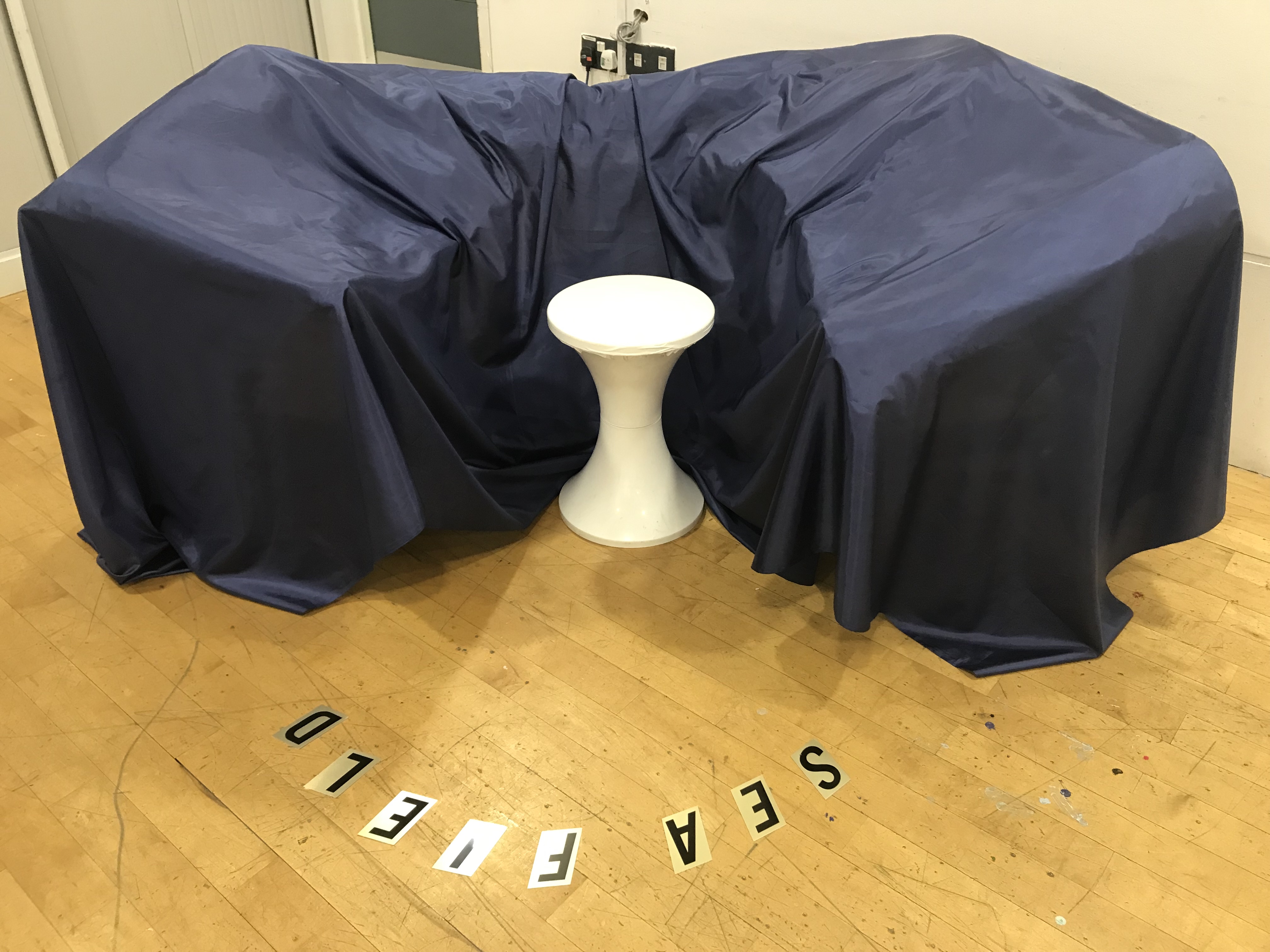
- 14.00 - 20.00 Studio 3 - Hugh Huddy: Seafield. image | notes 1 2 | pdf | video | Behind the installation | Reflections
- 14.00 - 20.00 Studio 4 - Nina Danon, Francesco Cassino, Lily Hope: Volcano. website | image |listening guide | Listening Station audio | Installation audio
- 14.00 - 20.00 Main Hall and Cafe - Pete Batchelor & DMU students: Aural Diversity listening stations | download images
- 14.00 - 15.00 Main Hall - Ed Garland, Josephine Dickinson, Jay Afrisando: your awe or oar or ore or audio or order? videos: Timestamped Experiences | Simultaneous Writing
- 15.00 - 16.00 Main Hall - Will Renel: Should We Listen to the Man on the Clapham Omnibus? (installation).
- 16.00 - 16.30 Main Hall - Rosa Francesca: Improvisa Live. images 1 2
- 16.30 - 17.00 Main Hall - Andrew Hugill: Digital Syzygies. image | website
- 17.00 - 18.00 Main Hall - Russ Palmer & Stina Ojala: Feeling and interacting with musical instruments. video | image
- 18.00 - 20.00 Studio 1 - Amit Patel/Simon Atkinson: Undertone. video | download image collection | download full documentation
- 18.00 - 19.00 Main Hall - Will Renel: Should We Listen to the Man on the Clapham Omnibus? (installation).
- 19.00 - 20.00 Main Hall - Ed Garland, Josephine Dickinson, Jay Afrisando: your awe or oar or ore or audio or order? (installation).



DAY 2: Sunday January 22nd
College Court Conference Centre, Knighton Road, Leicester LE2 3UF
- 09.00 Tea and coffee
- 09.20 Welcome (Andrew Hugill)
- 09.30 - 10.00 John Drever: Paracusis Loci - Spatial Perception of Aural Diversity. | video
- 10.00 - 10.30 Alfie Cliff: Localisation through Bone Conduction Audio. | video | script
- 10.30 - 11.00 BREAK
- 11.00 - 11.30 Matthew Frost: Musicians Accessing Audiology - Identifying barriers and facilitators for musicians seeking audiological support. | video | script
- 11.30 - 12.00 Duncan Chapman: The Aural Diversity Concerts: multimodal performance to an aurally diverse audience. | video | script
- 12.00 - 12.30 Andrew Hugill: An electroencephalogram-driven AI composition and performance system for autistic and/or d/Deaf musicians. | video | script
- 12.30 - 13.30 LUNCH
- 13.30 - 14.00 Beverly Biderman (online from Toronto): Not Just 'Marbles Rolling Around in a Dryer': Cochlear Implants and Music. | video | script
- 14.00 - 14.30 Liisa Sammalpenger (online from Finland): Music Performance Accessibility. | video | script
- 14.30 - 15.00 BREAK
- 15.00 - 15.30 Andrew Hugill: The Aural Diversity Network: Final Report. | video
- 15.30 -16.30 PLENARY DISCUSSION: What next for the Aural Diversity Network?
PROGRAMME IN DETAIL
DAY 1: Saturday January 21st, 14.00 - 20.00
Attenborough Arts Centre, Lancaster Rd, Leicester LE1 7HA
- 14.00 - 17.00 Studio 1 - Ricardo Huisman: The Bone Conductor (presentation and interactive installation).
- 14.00 - 20.00 Studio 3 - Hugh Huddy: Landscape Listening Chair (installation).
- 14.00 - 20.00 Studio 4 - Nina Danon, Francesco Cassino, Lily Hope: Volcano (installation).
- 14.00 - 20.00 Main Hall and Cafe - Pete Batchelor & DMU students: Aural Diversity (listening stations).
- 14.00 - 15.00 Main Hall - Ed Garland, Josephine Dickinson, Jay Afrisando: your awe or oar or ore or audio or order? (installation).
- 15.00 - 16.00 Main Hall - Will Renel: Should We Listen to the Man on the Clapham Omnibus? (installation).
- 16.00 - 16.30 Main Hall - Rosa Francesca: Improvisa Live (performance).
- 16.30 - 17.00 Main Hall - Andrew Hugill: Digital Syzygies (performance).
- 17.00 - 18.00 Main Hall - Russ Palmer & Stina Ojala: Feeling and interacting with musical instruments (performance/talk).
- 18.00 - 20.00 Studio 1 - Amit Dinesh Patel/Simon Atkinson: Undertone (installation, with vibrating floor).
- 18.00 - 19.00 Main Hall - Will Renel: Should We Listen to the Man on the Clapham Omnibus? (installation).
- 19.00 - 20.00 Main Hall - Ed Garland, Josephine Dickinson, Jay Afrisando: your awe or oar or ore or audio or order? (installation).
'The bone conductor'- installation / research project: invites experiencing a tactile sound sculpture: the 'woollen sound bone' combined with bone conducting headphones. It started as playful introduction to the principles of bone conduction, making composed soundscapes audible and tangible and sharing our personal 'multi sensorial hearing perspectives' (artistic research) because we all hear differently in multi modal ways. Exploring further possibilities for an aural diverse public.
Ricardo Huisman, 1960, Amsterdam based, interdisciplinary, socially engaged sound image artist, soundscape composer, artistic researcher, art teacher, inspired by avantgarde and acoustic ecology, creates inclusive interactive tactile sonic sculpture installations. His woollen sound sculptures produce tangible, audible composed 'sensescapes', causing an intimate, intensified personal multisensory hearing experiences that reveal multiple associative dimensions, reminiscences, bodily sensations, giving rise to new spaces for imagination, knowledge and more awareness of the sound habitat where we live and work.
This piece is just a simple chair between some loudspeakers, but it's also about the powerful illusion of physical space. How we may sense and even 'feel' the presence of physical space through our ears. Hearing, as it lets us experience and even re-experience the feeling of being somewhere. A sound-photograph of a real place, that you begin to see, more and more clearly, as you sit and continue to listen.
Hugh Huddy is a kind of sound artist who has come to describe himself as a 'sound landscape photographer'. His mission is to capture the sound-feel of places in perfect spatial detail. Hugh says despite constantly striving he's never achieved the perfect spatial detail goal, but his mission has made him even more fascinated in spatial hearing and how we interpret and remember our own lived aural experiences.
This sound installation for loudspeakers and vibrating floor takes the audience on a multi-sensory journey to the centre of the earth. Inspired by the magnificent volcanic cavern Algar do Carvao in the Azores, the piece is constructed to musically evoke the shapes, colours, textures and tactile sensations experienced when descending into this ancient volcano, bringing to life the rich geological history of the island of Terceira.
Nina Danon is a French and Italian composer and sound artist, currently investigating compositional techniques based on the auraldiversity of neurodivergent musicians as part of her PhD at Goldsmiths, University of London. Francesco Cassino - Comakid - is an Italian and British naturalised producer, multi-instrumentalist and sound designer. He specialises in sound synthesis techniques and in his most recent work, he's been exploring the artistic application of both human and technology limitations. Lily Hope is a spirited English cellist who holds passion for music that encourages self expression and shared understanding. Lily is currently exploring interests in new music, cross-arts collaboration and music with narrative, as well as promoting representative programming and accessibility for audiences.
Students from the Final Year Community Arts module at De Montfort University have been considering a variety of aspects of Aural Diversity during their autumn term, including synaesthesia, tinnitus and other aural disturbance, the universally unheard, and technological hearing interventions. They will present installations which explore these through sound, light and sculpture.
[your awe or oar or ore or audio or order?] is a collaborative arts-based research project exploring the relationships between sound, language, and memory from a range of aurally diverse perspectives. This project uses a combination of video, audio, and text, manifesting in a two-part installation. The 1st part is a record of simultaneous writing sessions responding to sounds and memories of real-time and past aural experiences. The 2nd part is a record of timestamped experiences exhibiting soundscapes of inner and outer bodies. By interweaving the strands of research already present in Jay Afrisando's, Josephine Dickinson's, and Ed Garland's works, this project questions the role of language, memory, and interpretation in aurally diverse perspectives and probes the conceptual boundaries between perception, memory, and imagination.
Josephine Dickinson studied composition with Michael Finnissy and Richard Barrett. She has published four collections of poetry and has collaborated extensively with artists, musicians and writers. Profoundly deaf since childhood, she became totally deaf in 2012. Her experiences throughout this and after receiving a cochlear implant have given her new insights into sound and a curiosity about its phenomenology, and how this can inform artistic practice.
Ed Garland is the author of Earwitness: A Search for Sonic Understanding in Stories, which was the winner of the New Welsh Writing award in 2018. He recently completed a PhD at Aberystwyth University, with a thesis entitled Sonic Experience in Contemporary Fiction. He has noise-induced hearing loss and tinnitus, and wears RIC hearing aids. He is currently working on more essays about sound and reading, and an ongoing arts project called Pharmaceutical Percussion.
Jay Afrisando is an award-winning multimedia artist, composer, researcher, and educator. Employing multisensory and antidisciplinary approaches, he raises awareness of aural diversity, acoustic ecology, and cultural identity. He shares vital experiences and disseminates knowledge through various means, including video, spatial audio, fixed media, improvisation, and various collaborative methods.
Through interlocking layers of voice, sound, image and text a group of deaf, disabled and neurodivergent people explore what auraldiversity means to them.
Will Renel is a practice-based researcher and sound artist with an interest in sonic inclusion - the multiplicity of ways that sound makes us feel included or excluded from society.
Improvisa Live is a piece of contemporary classical music composed live using the Muse EEG monitor. Data is streamed from an EEG headset via Bluetooth and is compiled into a composition in traditional music notation using Max MSP's bach library. The EEG data is used to determine pitch, range and rhythm. As the newly generated score is performed live, the headset is already generating the next few bars of music, thus creating a feedback loop and demonstrating how the brain is affected by hearing and producing music in realtime. This performance is adapted from a 2019 project.
Rosa Francesca is a digital artist from Leamington Spa whose work focuses on the themes of the body and accessibility. Rosa often experiments with biofeedback and facial recognition to find innovative ways for people with limited mobility to make music and art. Her work ranges from 3D renders to performance and interactive installations.
Digital Syzygies is a set of neural-controlled musical works created by four aurally divergent and/or autistic musicians. It uses a novel compositional and performance process in which the performance metrics of an eeg-reader are translated into musical signals by a Python app. The outputs of the system are combined to create a collection of 'syzygies' (alignments).
Andrew Hugill is Deputy Director of the Institute for Digital Culture at the University of Leicester. He is a composer and Professor of Music. In 2009, Meniere's destroyed much of his hearing. In this work he has collaborated with Anya Ustaszewski, Elisabethe Wiklander and Simon Allen.
For hearing impaired or dual-sensory impaired people instruments being played on stage may not be fully appreciated. Some people need to touch or feel the instruments to get a holistic and realistic experience including the vibrations produced. Then, one can feel and experiment the instrument by using different types of touch techniques: tapping, stroking, or hitting - in other words, using haptic exploration methods. This session will present an opportunity for the hearing and dual-sensory impaired people to experience music in a holistic manner in real- time. This brings the sounds close to the individual and gives a greater appreciation of the soundscape around them.
Russ is an International Music Therapist and Vibroacoustic Therapy Practitioner. Born severely deaf, he has Usher Syndrome, is registered deafblind and uses two cochlear implants (CIs). Russ' philosophy is called 'Feeling the Music'; through musical expression and therapy he applies a concept of how people who are losing their hearing and sight can feel musical vibrations. Stina is a speech researcher and phonetician at the University of Turku, Finland.
Undertone explores relationships between vibration, frequency and rhythm, mixing the artists' electroacoustic music, lowercase sound, noise and bass culture sensibilities.
Amit Dinesh Patel, aka Dushume, is an experimental noise and sound artist, influenced by Asian underground music and DJ culture. His work focuses on performing and improvising with purpose built do-it-yourself instruments, and recording these instruments incorporating looping, re-mixing and re- editing techniques. Lack and loss of control are central to his work. He has a PhD in Music, "Studio Bench: the DIY nomad and Noise Selector" (2019), from the Music, Technology and Innovation Research Centre, De Montfort University, Leicester, UK. He is a member of the Sound/Image Research Centre at the University of Greenwich, London, and Principal Investigator for the AHRC Research Grant "Exploring Cultural Diversity in Experimental Sound" (2021-22). www.dushume.co.uk
Simon Atkinson has a background in music and music technology education. Since 2000 he has lived and worked in Leicester, for many years leading the development music technology courses at De Montfort University where he is Associate Professor and a founding member of the Music, Technology and Innovation Research Centre (MTI). He works in music composition, often exploring opportunities made possible through digital technologies, and often exploring the evolution of timbre and texture over time. He has also worked in a very eclectic range of inter-art form projects, collaborations, and community-based projects, including installation, performance, work for screen and dance.
See above for details
See above for details
DAY 2: Sunday January 22nd
College Court Conference Centre, Knighton Road, Leicester LE2 3UF
- 09.00 Tea and coffee
- 09.20 Welcome (Andrew Hugill)
- 09.30 - 10.00 John Drever: Paracusis Loci - Spatial Perception of Aural Diversity.
- 10.00 - 10.30 Alfie Cliff: Localisation through Bone Conduction Audio.
- 10.30 - 11.00 BREAK
- 11.00 - 11.30 Matthew Frost: Musicians Accessing Audiology - Identifying barriers and facilitators for musicians seeking audiological support.
- 11.30 - 12.00 Duncan Chapman: The Aural Diversity Concerts: multimodal performance to an aurally diverse audience.
- 12.00 - 12.30 Andrew Hugill: An electroencephalogram-driven AI composition and performance system for autistic and/or d/Deaf musicians.
- 12.30 - 13.30 LUNCH
- 13.30 - 14.00 Beverly Biderman (online from Toronto): Not Just 'Marbles Rolling Around in a Dryer': Cochlear Implants and Music.
- 14.00 - 14.30 Liisa Sammalpenger (online from Finland): Music Performance Accessibility.
- 14.30 - 15.00 BREAK
- 15.00 - 15.30 Andrew Hugill: The Aural Diversity Network: Final Report.
- 15.30 -16.30 PLENARY DISCUSSION: What next for the Aural Diversity Network?
- What has been the impact of the network?
- What have we learned?
- What research lines or areas have emerged?
- What new collaborations have occurred?
- What are the likely funding bids?
- How should the network continue?
- How may music and performance best address the wide range of aural diversities?
- What are the technical, aesthetic and sociocultural consequences of aural diversity for musical practice and theory?
- How does aural diversity affect aural skills training?
- What technologies exist or may be created to support musical engagement by aurally diverse practitioners and how may aurally diverse audiences be reached?
- What are the historical contexts and characteristics of aural diversity that have affected music?
- How may we envisage a new kind of music-making that encompasses every kind of listener?
- How may discussions of equality, diversity and inclusion in music be improved by awareness and acceptance of aural diversity?
- 1 November 2022 Deadline for abstract submissions
- 1 December 2022 Review outcomes
- 21-22 January 2023 Workshop event (face-to-face)
- Structured abstract of max 300 words
- Empirical studies: Background, Aims, Methods, Results, Conclusion and Implications
- Non-empirical studies: Background, Aims, Main Contribution, Conclusion and Implications
- Demonstrations: Background, Aims, Main Contribution & Practical requirements.
- Structured abstract of max 300 words for panel as a whole: Background, Aims, Main contribution.
- Overview of presentations including titles, authors, and selected hubs.
- Structured abstract for each contribution, following the guidelines for single submissions, submitted separately
- The title
- The authors' names
- Type of proposal (presentation, workshop, demonstration, symposium)
- Your institutional affiliation(s)
- The email address of the lead author
- Where you are based nationally/internationally
- What time zone you are in (-5 UTC Americas, +1UTC West-Europe, +4 UTC East etc.)
This talk will explore spatial perception through an aurally diverse (Drever 2015, Drever & Hugill 2022) frame, the implications for design when hearing diverges from the normative / auraltypical spatial blueprint and creative strategies that represent or address aurally divergent spatial perception. The starting point for this paper is that the standard practice in acoustic design, acoustic architecture (Blesser & Salter 2007) and audio engineering is predicated on an otologically normal, symmetrical auditory space experienced as a continuum - space being that "totality of all possible positions of auditory events" (Blauert). For example, it is fundamentally inscribed into our audio formats and technology; the stereo image is predicated on the notion of the sweet spot that demands a pair of identically functioning (binaural) ears. In Poitzer's foundational text on otology, Lehrbuch der Ohrenheilkunde (1878-82), he introduces the concept of paracusis loci, auditory spatial impairment. He focuses on the localisation of sound, "the inability to point out the locality and the direction from which sound has come", but we could include a much wider range of spatial impressions (Mason 1999) such as the dimensions of sources and the distance from the listener, and the dimension and features of the environment that the sources and listener are situated. This includes the promise from VR of envelopment or immersion. The keystone pedagogic text on concert hall acoustic design of Barron (2010) and Beranek (1996) places the listener at the centre of the concert hall experience and has developed highly nuanced criteria regarding direct and reflected sound and resonance of the space in relation to the position of the listener, however throughout, the listener is assumed, as in the words of modernist composer Babbitt "a suitably equipped receptor" (Babbitt 1958). But if we look deeper, we can find a growing understanding of paracusis loci. This talk will explore the characterisation of different forms such as occlusion (with the amplification of internal sounds) and periscopic listening (Ronnell) such as the sonic experience of breaststroke, with one ear submerged. We will also explore expanded spatial perception. In conclusion, it will begin to offer a more lived understanding of spatial perception and the consequences for the way in which we relate to the built environment.
John Levack Drever operates at the intersection of disciplines that deal with sound including acoustics, audiology, environmental studies and sound art. He has a special interest in soundscape methods, in particular field recording and soundwalking. In 1998 he co-founded the UK and Ireland Soundscape Community (a regional affiliate of the World Forum for Acoustic Ecology). He was awarded a PhD from Dartington College of Arts in 2001. Drever is an avid collaborator and a member of Blind Ditch. He has devised sound in many different configurations and contexts. Commissions range from the Groupe de Recherches Musicales, France (1999) to Shiga National Museum, Japan (2012). Most recently he collaborated with Ruralrecreation on the School of Insects (2021-22) at Trumpington Park Primary School. Drever is Professor of Acoustic Ecology and Sound Art at Goldsmiths, University of London, where he co-leads the Unit for Sound Practice Research (SPR). He first presented the concepts of auraltypical hearing and auraldiversity at Hearing Landscape Critically: Music, Place, and the Spaces of Sound at Harvard University in 2015. Together with Andrew Hugill, Drever edited Aural Diversity (Routledge 2022).
In a world where immersive audio experiences are becoming more desirable through systems such as virtual reality and cinema; is bone conduction audio capable of making these experiences more accessible? This talk will discuss the results of a 5.0 surround sound bone conduction headset and the potential use of bone conduction to produce spatial audio.
Alfie Cliff is an audio engineer with a particular interest in bone conduction and sound design. He is a graduate of BSc Music Technology from Birmingham City University.
Media attention regarding musicians' hearing damage has been relatively high during the last five years. Since Christopher Goldscheider successfully sued the Royal Opera house in 2016 for acoustic shock, a growing number of musicians from many backgrounds have spoken out about their hearing concerns. This has ranged from interviews with musicians such as drummers Jamie Morrison and Myles Kennedy, to KT Tunstall cancelling her music tour, before Darius Marder's Film 'Sound of Metal' captivated audiences around the world with the story of a drummer losing his hearing. Whilst the causes of hearing damage are well-documented, there is limited peer-reviewed research regarding how professional musicians are affected. This talk will discuss the findings of a literature review and research project regarding what is currently known about the risks to musicians' hearing health, their attitudes towards hearing healthcare, and the barriers/facilitators they face when trying to access audiological services.
Matt Frost works as a hearing aid dispenser for Harley Street Hearing & The Musicians' Hearing Services. Prior to this he graduated as an Orchestral Percussionist from the Guildhall School of Music & Drama and has worn hearing aids since the age of 17.
In this talk, I will explore the creation of the second Aural Diversity concert in Leicester in 2019. In particular, I will talk about the creation of the piece " Like fresh snow, bells and leaves " which involved collaboration with a group of people with a range of experiences of hearing. I started with simple questions about sound, place, and the experience of hearing change and created the composition from a mixture of recorded speech and field recordings. I will explore some of the thinking behind the presentation of the event and how some of this can be used to develop work in the future. I will also talk about the nature of collaborative work for a variety of contexts including some of the opportunities of online and blended performance. The talk will include several audio examples from the concert in 2019 as well as other linked works.
Duncan Chapman: composer/musician based in Lincolnshire UK. Much of his work involves collaborations with a wide range of people creating performances, installations & recordings. Recent projects include curating a concert for the Aural Diversity project and writing a book chapter about the experience. He was a keynote speaker for the 2022 Orff society conference and is in the process of co-writing a paper on telematic improvisation with Dr. Mike McInerney for the Noisefloor festival. Recent performance projects include morning music with Supriya Nagarajan at the Jaipur Literature Festival in India, online performances with Comb Filter (with Simon Limbrick and Adrian Lee), and Humbox (with Mike McInerney). Other recent work includes an album of marimba and live electronic pieces with Simon Limbrick, a residency at EMS in Stockholm, performances (with Supriya Nagarajan) of Lullaby:Sonic Cradle at Radiophrenia in Glasgow, Casa Da Musica (Porto) and at the 2022 WOMAD festival. Solo work is on Silent, Takuroku & Linear Obsessional labels as well as several collaborative albums on Mushinoise & Manasamitra online labels. He is a mentor for Sound And Music's Listen Imagine Compose project, a trustee of Liquid Vibrations, and has been a contributor to courses at York, Aberdeen, Goldsmiths, Limerick, and De Montfort Universities.
This paper reports on a project to initiate a new form of digital musicianship that enables traditionally marginalised groups such as autistic people and deaf musicians to create and perform original music. It uses an EEG-driven AI to explore the individual sound worlds of the musicians and make connections between them. The system interprets neural performance metrics based on the musicians' reactions to sensory stimuli. An algorithm then distributes the resulting sounds to provoke new reactions, implementing a feedback loop of unconscious creativity. The first part of the project was a pilot study entitled Digital Syzygies (2022), led by Professor Andrew Hugill as part of the 'Digital Scores' project, funded by the European Research Council. In this Case Study, four remotely located autistic and/or deaf musicians used a self-devised system in the manner described above.
Andrew Hugill is Deputy Director of the Institute for Digital Culture at the University of Leicester. He is a composer and Professor of Music. In 2009, Meniere's destroyed much of his hearing.
When I first received my cochlear implant in Canada in 1993, almost 30 years ago, I was told by one recipient that music sounded like "marbles rolling around in a dryer." In this presentation, based on my personal experience I will show that this need not (always) be the case. I have been profoundly deaf since my early teens, and severely hard of hearing from toddlerhood. When I received my first implant (I now hear with two), I was 'warned' that cochlear implants were developed for speech, and not suitable for music. That misconception about cochlear implants and music has unfortunately persisted. I will present instead a more nuanced understanding of music appreciation based on my personal experiences as a cochlear implant user learning, over time - and with determination - to enjoy music.
I am the author of a memoir of growing up deaf and learning to hear with a cochlear implant: Wired for Sound: A Journey into Hearing (rev. 2016). The original edition was favourably reviewed by Dr. Oliver Sacks, and named an American Library Association Choice Outstanding Academic Title. The memoir has also become the basis of an opera (Standing on the Threshold of the Outside World) by Carlos A. Augusto. I am a former Chair of the Board of Canadian Hearing Services.
How can you enjoy a music performance if you cannot hear? Let your body listen. This requires many trials and errors as there are no ready-made solutions and each person has their own preferences on how to feel music. The solutions fall into two categories: technological devices and the non-technological approach. Most often the best solution is a combination of devices and objects, and requires multi-tasking. If one reads music then sheet music is a direct albeit encoded way of following the movements of music in time, but one still needs someone to follow the notation with the pace of music. Notation is a similar code to written language in books. There are also Braille music books and Braille notation available. Still, you need to read and understand notation to be able to follow the sheet music. Speech-to-text interpreters are able to provide text descriptions of the soundscapes of the music and how it moves. Sometimes it is best to adapt the hands-on approach to music, be it hands on an instrument, hands feeling the vibration on the surfaces and structures of the music venue or actually being hands-on to the singer. You can also even ask the drummer to drum on your back. Some of us are so sensitive to the vibrations of the music that they can feel the vibrations created by the music directly on air, especially near the loudspeakers. Sadly, some of the technological devices in use have become out-dated and their development has ceased. Nevertheless, some of those devices are a life line to the people using them and there is a dire need of a keen developer so that the old devices could get a new release of life and continue bringing music and happiness to the end users' lives.
Liisa is an Expert by Lived Experience at the Finnish Hearing Association and a Vibrac Level I student.
Andrew summarizes the activities and achievements of the network in advance of the end of its AHRC funding in February. He offers some reflections and thoughts for future directions to stimulate discussion.
The discussion will address the following questions:
Call for Papers
It is clear that listening encompasses a far greater range of hearing types than has heretofore been generally acknowledged. The following questions may stimulate proposals and papers:
The Aural Diversity Network Music and Performance two-day workshop will examine these questions, in an interdisciplinary context that includes the arts and humanities alongside technical and scientific fields.
Submissions may consist of proposals for: spoken papers, demonstrations, thematic panels. British Sign Language interpretation will be provided on request. Please request BSL, if required, on registration.
Important dates
Submission guidelines
- for single paper or demonstration:
- for thematic panel:
Your proposal must further include:
How to submit: Please submit your proposal via email to: info@auraldiversity.org