


Andrew Hugill gratefully acknowledges the contributions of many members of the Aural Diversity Network in creating this infographic. Version 1.6 published October 23rd 2022. To cite:
Hugill, A. (2022) 'Aural Diversity Infographic'. Available at https://auraldiversity.org/infographic.html
ABOUT
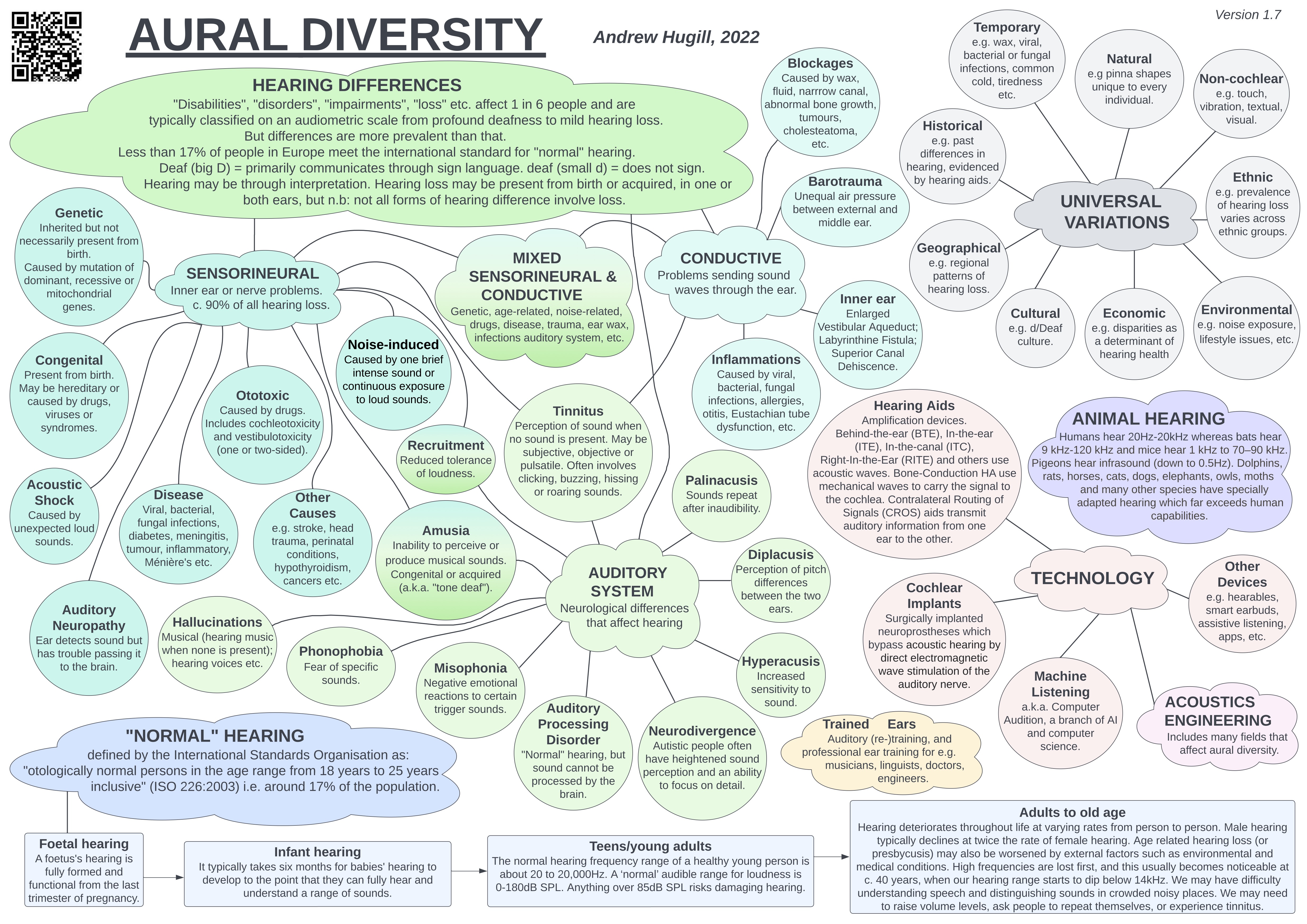
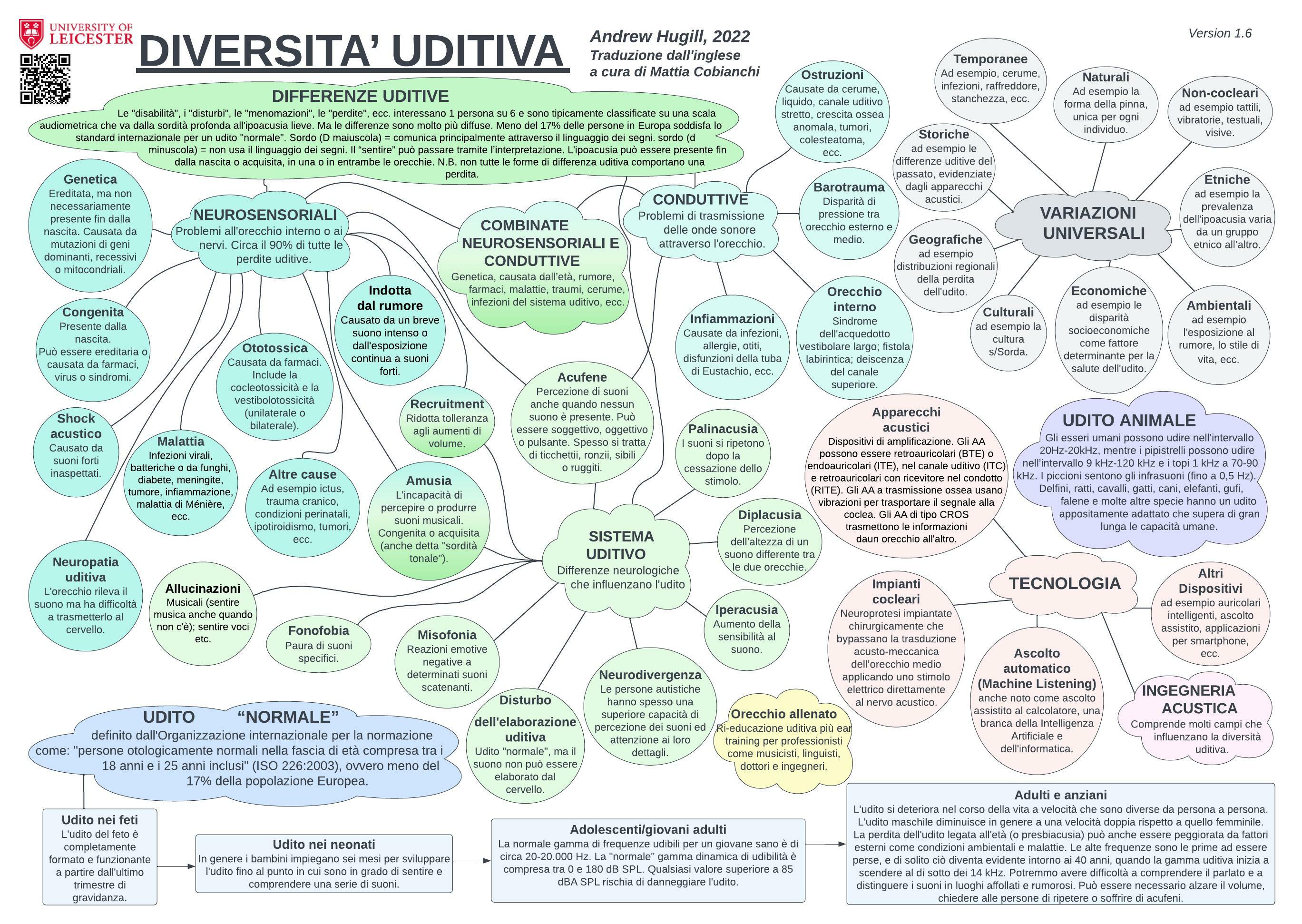
Aural Diversity begins with a simple observation: everybody hears differently. Yet most hearing and listening situations assume a single, shared auditory norm. This infographic offers a high-level map of the complexity of aural diversity, including universal variation and extending beyond human hearing to animal and machine listening.
The blue band at the bottom traces the trajectory of so-called “normal” hearing — typically defined by reference to healthy 18–25-year-olds (BS ISO 226:2003). In reality, this group represents only a small proportion of humanity at any given moment. The auditory system continues developing after birth, and age-related hearing change (presbycusis) begins early in adulthood, progressing at different rates across sex, ethnicity, and environment. The idea of a stable “normal ear” is therefore more theoretical than real.
The green field indicates the wide range of hearing differences. These include congenital and genetic variations, sensorineural conditions affecting the inner ear and auditory nerve, conductive differences affecting sound transmission, and mixed profiles. Causes range from inheritance and trauma to drugs, noise exposure, and viral illness. Tinnitus — experienced by around 10–15% of people — may accompany many of these differences and fundamentally alters listening behaviour.
The neurological dimension reminds us that hearing is not only mechanical. Conditions such as hyperacusis (heightened sound sensitivity) and misophonia (strong emotional reactions to specific sounds) affect auditory experience in ways that challenge narrow definitions of “hearing loss.” For some neurodivergent and autistic people, auditory difference is foundational to lived experience. Aural Diversity therefore moves beyond purely medical frameworks. Drawing on the social model of disability, it recognises that environments — not individuals — are often disabling. This does not deny the real consequences of hearing loss; rather, it affirms that diverse auditory states are integral forms of being.
The grey region identifies universal variations shaped by environment, culture, history, and socioeconomic conditions. People in different centuries, climates, occupations, and cultures hear differently. Epidemiological studies show variation in hearing loss prevalence across populations. d/Deaf culture has further expanded what “hearing” means, extending it into vibration, sight, language, and non-cochlear forms of listening.
The purple section represents animal hearing, which far exceeds human diversity in range and capacity. Bats and elephants are well-known examples, but species such as pigeons and moths demonstrate extraordinary auditory capabilities. Human hearing exists within a far wider biological spectrum.
The pink section considers technological mediation. Hearing aids, cochlear implants, assistive apps, hearables, and AI-embedded systems transform auditory experience, sometimes blurring the boundary between biological and machine listening. These technologies create new perceptual realities. Yet uptake of hearing technologies remains limited worldwide, meaning most auditory diversity remains unrecognised in policy and design contexts.
Aural Diversity therefore invites us to reconsider what we mean by hearing, listening, normality, and inclusion. It provides a framework for research, design, policy, and creative practice that acknowledges the full range of auditory experience.
Andrew Hugill
https://andrewhugill.com